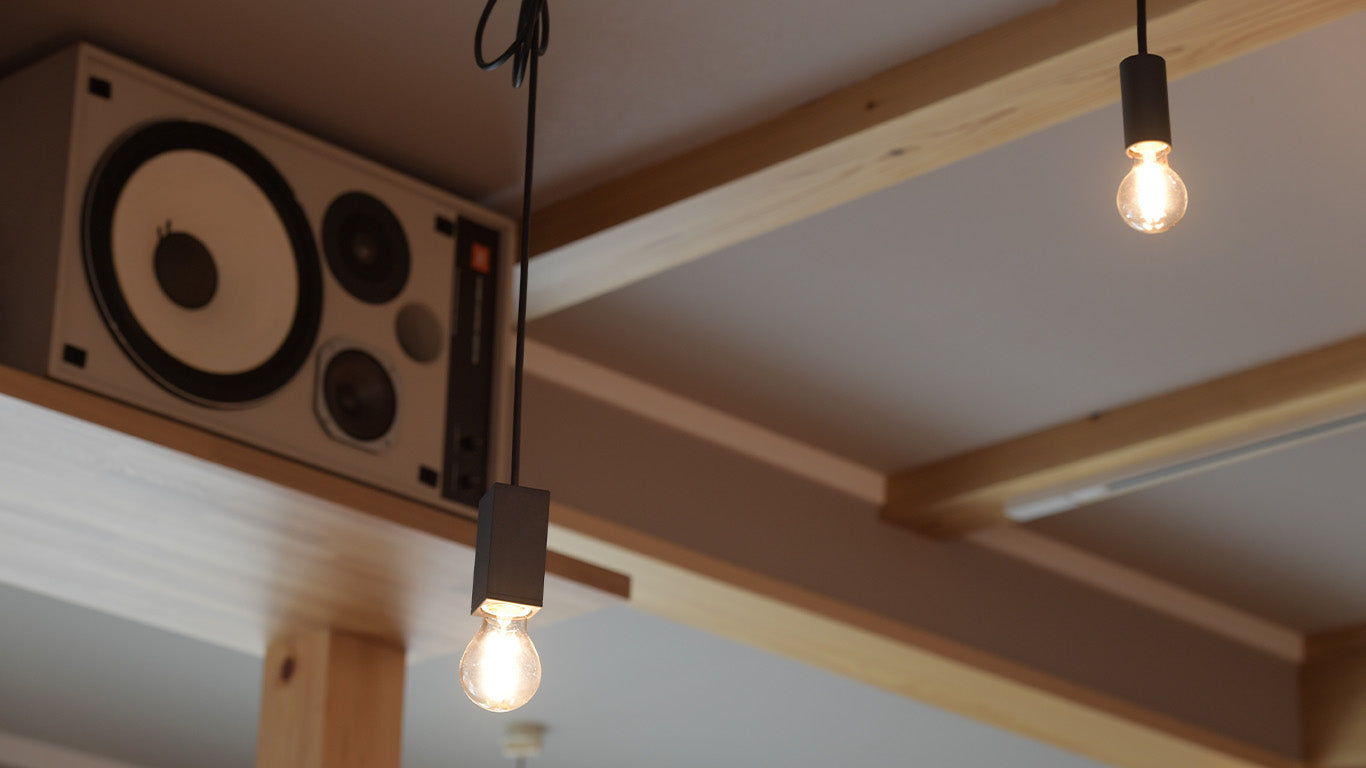
Lighting has slightly different roles depending on the time of day.
This time, we will talk about the **"difference in the role of lighting between day and night"** and the3 ways of thinking about brightness to make your living space more comfortable.
When you think of lighting,
"something that brightens up dark spaces"
is probably the image many people have.
Of course, that is an important role of lighting.
But in reality, lighting is involved not only at night when it is turned on, but also in spaces during the day.
During the day, it is a time when the shape and material of the lighting itself can be seen as interior decor.
At night, it is a time to create the atmosphere of the space through the spread of light and shadows.
Being aware of this difference will slightly broaden your perspective when choosing lighting.
During the day, think about "how the lighting fixture itself looks"
During the day, even if the lighting is not turned on, the lighting fixture exists in the space.
Shape.
Material feel.
Size.
How it hangs from the ceiling.
Balance with furniture and walls.
These elements change the impression of the space during the day.
For example, the soft luster of brass and the sharp contours created by machining clearly convey their texture even in natural light.
When choosing lighting, not only the brightness when turned on, but alsohow it looks when turned offis important.
Daytime lighting is not so much about brightening the space as it is about shaping the impression of the space as part of the interior.
At night, think of "necessary brightness" and "relaxing brightness" separately
At night, lighting acts on the space as its original role:light.
However, nighttime lighting is not necessarily better the brighter it is.
A place to eat.
A place to relax.
A place to work.
A place to spend time before going to sleep.
The required brightness changes depending on the place and time.
For example, in the kitchen or dining room, you need brightness that makes it easy to see your hands and the dining table.
On the other hand, in the living room or bedroom, a slightly more subdued brightness may feel more comfortable than overly bright light.
For nighttime lighting, it is important to think of **"brightness that lets you see clearly"** and"brightness that makes you feel calm"** separately.
Use the color of the light to shape the impression of the space
Just as much as brightness, the color of the light also affects the impression of the space.
Clear white light makes the space look clean and tidy.
It is suitable for places where you work or want to create a sense of cleanliness.
On the other hand, warm light gives the space a calm impression.
It is a light that is easy to incorporate into spaces for mealtimes or for relaxing after coming home.
Especially at night, the atmosphere of the space changes greatly depending on the color of the light.
Even with the same lighting, simply changing the color of the light bulb can change how it looks and how comfortable it is to spend time in.
When choosing lighting, not only the design, but alsowhat color of light you want to spend your time inis something to keep in mind.

The difference in daytime and nighttime expressions seen with a white porcelain shade
As an example of how the role of lighting changes between day and night, CTSH LIGHT.'swhite porcelain shadeis a very easy-to-understand material.
During the day, you can enjoy the material feel of the white porcelain itself.
A soft whiteness.
The calm texture unique to pottery.
A presence that blends into the space while subtly leaving an impression.
On the other hand, when you turn on the light at night, the white porcelain shows a different expression.
Because white porcelain has the property of transmitting light, it softly receives the light of the light bulb, and a gentle light spreads from the entire shade.
During the day, it blends into the space as a material, and at night, it creates a warm atmosphere through light.
The white porcelain shade is a lighting fixture where you can easily feel different charms during the day and at night.

3 brightness levels to keep in mind when choosing lighting
When choosing lighting, keeping the following 3 brightness levels in mind will make it easier to choose lighting that suits the space.
1. Brightness to move safely
In the entryway, hallway, stairs, kitchen, etc., you need brightness that clearly shows your feet and hands.
2. Brightness that makes it easy to work
In places where you cook, read, get ready, etc., visibility suited to the purpose is important.
3. Brightness where you can spend time calmly
In the living room, dining room, bedroom, etc., by slightly reducing the brightness, the space will have a calm impression.
There is no need to make every place the same brightness.
By thinking about the brightness required for each place, it becomes easier to create a balance of light that suits your lifestyle.
This is the point!
Daytime lighting:
Even during times when it is not turned on, lighting creates the impression of the space through its material and shape.
Nighttime lighting:
By turning on the light, not only the brightness, but also the spread of light and shadows shapes the atmosphere of the space.
3 brightness levels:
By thinking of "brightness to move safely," "brightness that makes it easy to work," and "brightness where you can spend time calmly" separately, it becomes easier to choose lighting.
The enjoyment of CTSH LIGHT.:
Materials such as brass and white porcelain show different expressions during the day and at night. You can enjoy not only when it is turned on, but also how it looks when turned off.
Lighting is not just for brightening the space at night.
During the day, the material and shape blend into the space as interior decor.
At night, the spread of light and brightness creates a comfortable atmosphere.
When choosing lighting,
how it looks during the day.
what brightness you want to spend your time in at night.
Please keep both of those in mind.
By choosing light that suits your lifestyle, your daily space will become more comfortably arranged.