How to Choose Lighting Without Regrets
Learn from common mistakes to think about brightness, height, and placement.
When choosing lighting, many people first look at the design and materials.
Of course, choosing an appearance that suits the space is very important.
However, what people are most likely to regret after installation is not the appearance, but "brightness," "height," and "placement."
It was darker than I thought.
It's hung a little too low and feels in the way.
It ended up off-center from the table.
The light bulb is in my line of sight and it's glaring.
I can't get the balance with the downlights right.
Because lighting is used every day, these small discomforts are easy to notice in your daily life.
This time, to help you choose lighting without regrets, we will introduce how to think about brightness, height, and placement based on common mistakes.

[Mistake 1] I chose it based on design alone, and it was darker than I thought
A common mistake when choosing lighting is prioritizing design, only to find that the brightness is insufficient when you actually use it.
Pendant lights, in particular, spread light differently depending on the shape and material of the shade.
Types that cast light downward are good at illuminating tables or counters, but they may not be suitable for brightening the entire room.
Conversely, materials that spread light, such as white porcelain or glass, make it easier to deliver soft brightness throughout the entire space.
The important thing is not to look at the lighting as a single unit, but to consider the brightness needed for the entire space.
Are there downlights?
Are there other wall lights or floor lamps?
Will that lighting alone illuminate the space?
Or is it lighting intended to add atmosphere?
By clarifying this role, you can greatly reduce mistakes with brightness.
[Solution] Don't rely on a single light; combine light sources
Lighting does not necessarily need to brighten the entire room with just one light.
In fact, trying to illuminate the entire space with a single strong light can cause glare or make the space look flat.
We recommend the "multi-light per room" approach, where you place the necessary light in the necessary places.
A pendant light over the dining table.
Downlights in the kitchen to illuminate your work area.
Wall lights on the walls.
Floor lamps or indirect lighting in the living room.
By dispersing the light in this way, you can ensure brightness while creating depth in the space.
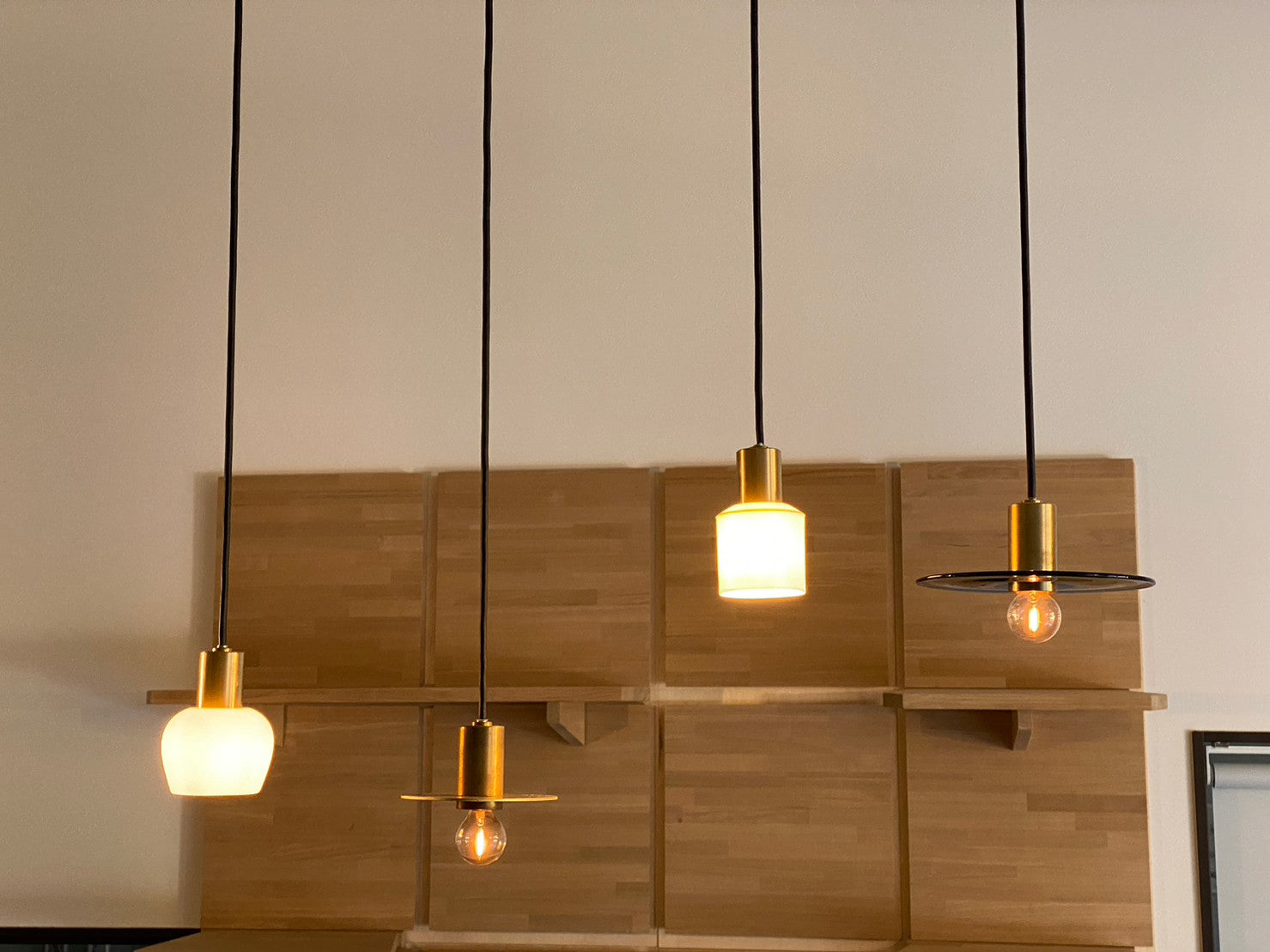
CTSH LIGHT.'s pendant lights are better appreciated when incorporated not as lighting that evenly brightens the entire space, but as lighting that allows you to enjoy the texture, shadows, and pools of light.
Of course, increasing the wattage (lumen value) of the light bulb is also effective.
[Mistake 2] I hung the pendant light too low
A common mistake regarding pendant light height occurs in dining rooms and kitchen counters.
Hanging it low concentrates the light on your work area and can create a cozy atmosphere.
However, if it's too low, it can obstruct your view, get in the way of work, or be glaring because the light bulb is in your line of sight.
Especially at kitchen counters, there are many situations where you work standing up, such as cooking, serving, and cleaning.
Therefore, even a slightly low lighting height can lead to difficulty in use.
It is important to consider not only the visual atmosphere but also how you actually move in that space.
[Solution] Aim for 70cm to 80cm from the countertop
When hanging a pendant light over a dining table or kitchen counter, aiming for about 70cm to 80cm from the countertop to the bottom of the light will make it easier to achieve a good balance.
At this height, it is less likely to interfere with eating or work, and the light source is less likely to be in your line of sight when seated.
However, this is just a guideline.
Ceiling height.
Table or counter height.
Brightness of the light bulb used.
Shape of the light shade.
Family height and lifestyle.
The ideal height will vary depending on these factors.
When in doubt, setting it a little higher makes it easier to reduce the feeling of being closed in or glare.
On the other hand, if you want to create a cozy atmosphere at the dining table, hanging it a little lower is also recommended.
*Method for adjusting after installation: If you want to make adjustments after installation, you can use adjustment items such as cord reels and cord adjusters, or store them inside the flange cup.
[Mistake 3] The position of the lighting was off from the table or counter
Surprisingly common is the mistake where the position of the lighting does not match the position of the furniture.
After installing the lighting according to the position of the ceiling hook, it ended up off-center from the table.
I lined up three lights on the kitchen counter, but the margins at the ends were uneven, making it look slightly unbalanced.
After replacing the dining table, the position of the lighting no longer matched.
If you determine the position of the lighting based only on the ceiling, it may end up out of alignment with the furniture and your lifestyle.
The important thing is to first think about "where you want the light to fall."
Base your thinking on where the light falls, not the position of the lighting fixture.
That alone will greatly change how you think about placement.
[Solution] Adjust the position with a track or hook
If you want to adjust the position of the lighting, you can use a track or ceiling hook.
Using a track makes it easier to fine-tune the position of the pendant light later.
It is also convenient when lining up three lights on a kitchen counter or when the position of the table may change.
Using a ceiling hook allows you to cast light in a location slightly away from the power outlet on the ceiling.
By extending the cord slightly and hanging it, you can create movement in the space and enjoy a cafe-like atmosphere.
You don't have to think of the position of the lighting as fixed.
Adjust the position of the light to suit your lifestyle.
By having that idea, the freedom of choosing lighting expands greatly.
[Mistake 4] I lined up multiple lights, and it looked a little busy
Three-light arrangements are popular in kitchen counters and dining rooms, but if the balance is wrong, it can feel a little cramped or look visually busy.
The spacing between the lights is too narrow.
The size of the fixtures is too large.
When these factors combine, even a well-thought-out three-light arrangement can end up looking a little heavy.
Multi-light arrangements are not just about increasing the number of lights.
The balance of spacing, height, brightness, and material texture is important.
[Solution] Spacing of 40cm to 60cm, with subdued brightness
When lining up three lights on a kitchen counter, aiming for a spacing of about 40cm to 60cm between the lights will make them look well-balanced.
Also, making the margins from both ends of the counter even will create a more orderly impression.
Additionally, when lining up three lights, it is recommended to make the brightness of each light slightly subdued.
Lining up three bright bulbs can sometimes feel unnecessarily glaring.
By placing multiple subdued lights, the light overlaps softly, creating a space with depth.
A three-light arrangement is not just for adding brightness, but is a lighting plan designed to create rhythm in the space.
[Mistake 5] The role overlapped with the downlights
In many modern homes, downlights are installed in the ceiling.
In that case, when adding a pendant light, you should consider the division of roles with the downlights.
If there is already sufficient brightness from the downlights, making the pendant light too bright as well can make the entire space feel glaring.
Conversely, relying only on a pendant light in a space without downlights may not provide enough brightness.
When choosing lighting, it is important to look not only at the brightness of the individual unit but also at the balance with the lighting already in place.
[Solution] If there are downlights, think of it as lighting that adds atmosphere
In a space with downlights, it is easier to achieve balance by incorporating the pendant light not as "lighting to ensure brightness," but as "lighting to set the atmosphere of the space."
For example, creating a pool of light over the dining table.
Adding a textured accent to the kitchen counter.
Adding the warmth of brass to a white space.
Creating soft shadows on the walls or ceiling.
The downlights support the overall brightness, while the pendant light sets the impression of the space.
By being aware of this division of roles, lighting planning becomes much easier.
Choosing lighting without regrets requires thinking with both numbers and intuition
In choosing lighting, numbers such as lumens, tatami mat measurements, and height guidelines are also important.
However, that alone does not determine the comfort of the space.
Where do you want to brighten?
Where do you want to leave shadows?
At what height do you want to place the light?
Do you want the lighting to be the main feature, or blend into the space?
These intuitive aspects are also very important in choosing lighting.
Brightness.
Height.
Placement.
Material.
Color of the light.
Balance with existing lighting.
By adjusting these little by little, lighting becomes not just a fixture, but an important element that creates the impression of the space.
Key Points!
To prevent mistakes with brightness
It is important to consider the brightness needed for the entire space, not just the lighting unit itself. Also, check the combination with downlights or auxiliary lighting.
To prevent mistakes with height
In dining rooms and kitchen counters, aiming for about 70cm to 80cm from the countertop to the bottom of the light will make it easier to balance usability and appearance.
To prevent mistakes with placement
It is recommended to base your thinking on where you want the light to fall, rather than the position of the power outlet on the ceiling. Using a track or hook also increases the freedom of adjustment.
The enjoyment of CTSH LIGHT.
By adjusting the brightness, height, and placement, the texture of the materials and the shadows of the light stand out even more beautifully. Lighting not only brightens the space but is also a tool for setting the impression of your daily life.
Recommended from CTSH LIGHT.