Lighting planning to ensure you have no regrets after placing your furniture.
Thank you for always supporting CTSH LIGHT.
This time, for those considering a new build or renovation, we would like to introduce the "positioning of lighting."
When it comes to lighting, choosing the fixtures is important, but just as important is "where to install them."
Even if you choose a pendant light you love, it may end up off-center from the table.
When you decide you want to install a wall sconce, you may find that there is no wiring in the wall.
The downlights may not align with the furniture, and the light may not reach the intended area.
These mistakes are not always caused by the lighting fixtures themselves, but by a lack of advance planning regarding their placement.
Especially in new builds and renovations, it can sometimes be difficult to change the position of the lighting later.
That is precisely why it is important to consider the position of the lighting at the same time you are planning the layout and interior design.
This time, we have outlined five check items to confirm in advance for lighting planning that you will not regret.

Is the position of the dining table decided?
The first thing to confirm is the position of the dining table.
When hanging a pendant light over the dining area, the light should ideally be centered over the table.
If you decide based only on the position of the ceiling junction box, the light may appear slightly off-center when the table is actually placed.
The placement of the dining table varies depending on the size of the room, the flow of movement, and the distance from the kitchen.
You may also replace the table with a different size or change its orientation.
During the new build or renovation stage, it is reassuring to confirm the following.
The size of the table.
The orientation of the table.
The flow of movement when chairs are pulled out.
The relationship with the kitchen and windows.
Whether to use one light or two or three lights.
For dining lighting, it is important to think about the center of the table rather than the center of the room.
Should lighting be arranged along the kitchen counter?
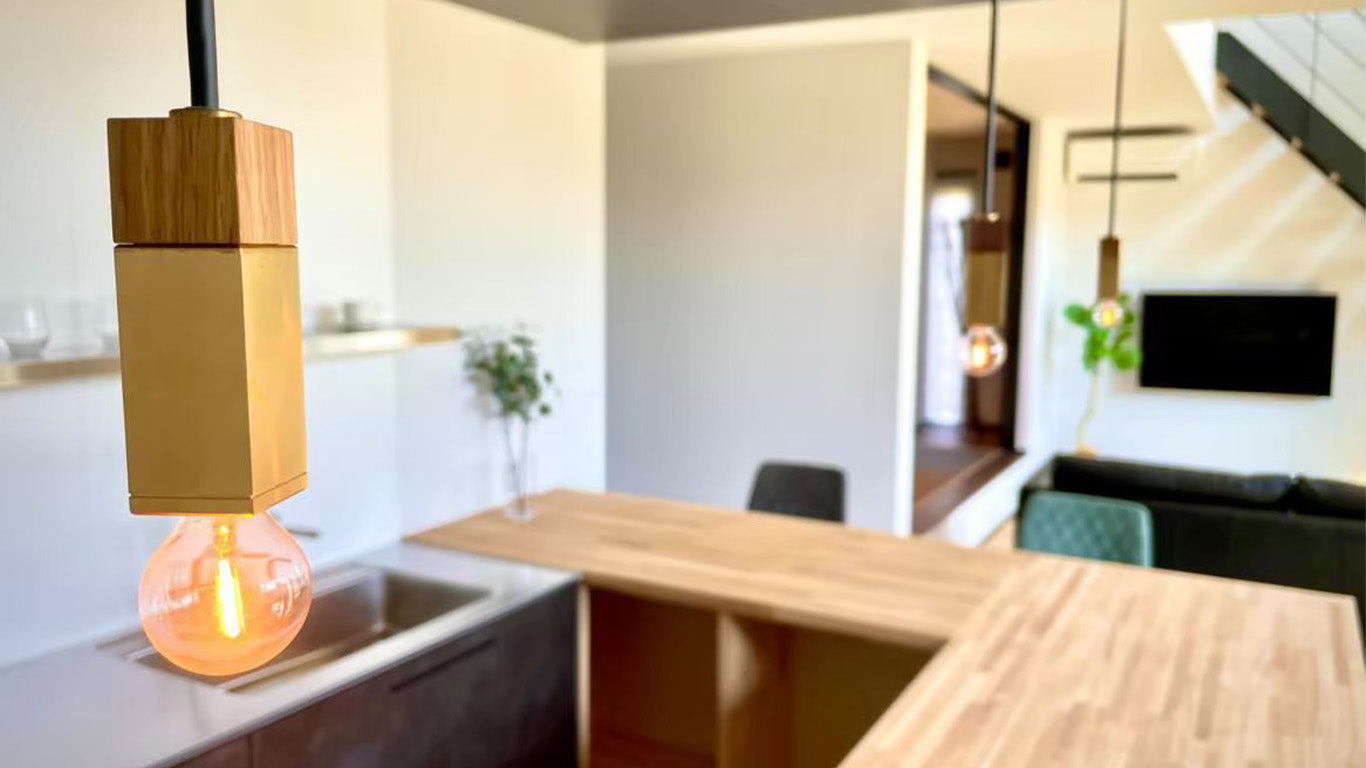
In kitchen counters and island kitchens, pendant lights are sometimes arranged in groups of two or three.
In this case, thinking in advance about the spacing between the lights and the margin from the edge of the counter will ensure a beautifully finished look.
When arranging three lights, spacing them about 40 cm to 60 cm apart will make them look well-balanced.
Matching the margins from both ends of the counter to the lights will also create a cleaner impression.
Also, functionality in the kitchen is important.
If they are too low, they will interfere with work at hand level.
If they are too high, the presence of the lighting will be weakened.
If they are too bright, they may feel glaring when combined with downlights.
If you want to arrange pendant lights along the kitchen counter, we recommend checking the ceiling power supply positions and the presence of track lighting at an early stage.
Are the roles of downlights and pendant lights separated?
In new builds and renovations, multiple downlights are often installed.
Downlights are lighting that excels at making the entire space look clean and bright.
On the other hand, pendant lights and wall sconces excel at highlighting textures, creating shadows, and establishing focal points.
Thinking about these roles separately will make lighting planning easier.
Use downlights to ensure overall brightness.
Use pendant lights to create a center of light over the dining table or counter.
Use wall sconces to add shadows to the walls.
Use floor lamps or indirect lighting to create a calm atmosphere at night.
There is no need for all lighting to have the same role.
Rather, by separating the light that illuminates the entire space from the light that creates an atmosphere, depth is created in the space.
For CTSH LIGHT. lighting, rather than illuminating the entire space evenly, it will bring out its charm even more if you incorporate it as lighting that allows you to enjoy the expressions of materials and the pooling of light.

Is there a wall where you want to install a wall sconce?
If you want to incorporate a wall sconce, early planning is important.
Unlike lighting that attaches to a ceiling junction box like a pendant light, wall sconces may require wiring in the wall.
Even if you decide later that you want to install one here, additional construction may be necessary if there is no wiring in the wall.
A soft light in the entryway when returning home.
A light in the hallway that creates shadows on the wall.
A lower light in the bedroom than ceiling lighting.
A textured accent in the washroom.
A light on the living room wall that creates depth in the space.
If you want to incorporate a wall sconce in these places, we recommend deciding the installation position and height at the design stage.
Wall sconces are not just lighting for brightening the entire space.
By placing light on the wall, they are lighting that quietly refines the impression of the room.

Are the switch positions and operation methods suited to your lifestyle?
Along with the lighting positions, you should also check the switch positions.
Even if you carefully consider the location of the lighting fixtures, if the switches are in inconvenient places, it will be a small stress in your daily life.
Can you reach them as soon as you enter the entryway?
Can you turn them off after getting into bed in the bedroom?
Can you operate only the necessary lighting separately in the kitchen and dining area?
Can you turn them on and off from both ends of the hallway?
Can you operate the wall sconces and downlights separately?
For lighting, not only where you turn it on, but also where you turn it off is important.
Especially when combining downlights, pendant lights, and wall sconces, it is convenient to separate the switches.
Only the pendant lights when eating.
Only the wall sconces at night.
Turn on the downlights as well when cleaning or working.
By being able to use them this way, it becomes easier to adjust the light according to the scenes of your life.
Calculate the lighting positions backward from the furniture and lifestyle
When deciding the lighting positions, you are likely to first look at the ceiling and walls and think about them.
However, what is truly important is what kind of life you will lead underneath.
Where will you place the table?
Where will you cook?
Where will you pass through?
Where will you relax?
Which wall do you want to make look beautiful?
Lighting is not something you add to the space at the end, but something you plan according to the flow of life.
At the new build or renovation stage, you have a high degree of freedom to arrange the lighting positions.
That is precisely why it is important to think about where you want the light to fall before choosing the fixtures.
Not only brightness, but the flow of sight.
Not only height, but the relationship with the furniture.
Not only design, but daily ease of use.
By checking each of these, you can greatly reduce the regrets of choosing lighting.
Key Points!
Dining:
We recommend thinking about the lighting not at the center of the room, but aligned with the center of the table.
Kitchen counter:
When arranging multiple pendant lights, make sure to check the spacing between the lights and the margin from the edge of the counter in advance.
Relationship with downlights:
If you arrange the overall brightness with downlights and the atmosphere and texture with pendant lights or wall sconces, depth will be created in the space.
Wall sconce:
Because wall-mounted lighting requires a wiring plan, it is reassuring to decide which wall you want to install it on at an early stage of the new build or renovation.
Switches:
By thinking about which light you will operate and where, it becomes easier to use different lighting according to the scenes of your life.
Enjoying CTSH LIGHT.:
By carefully planning the lighting positions, the expressions of brass, white porcelain, glass, and metal shades will be brought out even more beautifully. The new build or renovation stage is precisely the important timing to think about the position of the light.
Products featured in this construction example